Over 40% off PRINCE2 Project Management live virtual courses - code: P2PMSUMMER26TSG

14 October 2026 | Updated on 14 October 2026
The software testing life cycle (STLC) explained
The software testing life cycle (STLC) is a structured approach to organising testing activities throughout software development. One commonly used model describes six phases: requirement analysis, t...

The software testing life cycle (STLC) is a structured approach to organising testing activities throughout software development. One commonly used model describes six phases: requirement analysis, test planning, test case development, test environment setup, test execution and test closure. Entry and exit criteria can be defined for each phase, alongside its activities and deliverables, making the STLC a life cycle rather than a simple testing checklist.
What is the software testing life cycle?
The STLC provides a structure for moving testing from early analysis through to completion. Importantly, testing begins with requirements rather than waiting until finished software is ready to test.
Although the phases form a logical sequence, activities may overlap or repeat as the software changes.
Entry and exit criteria make that structure meaningful. Entry criteria establish what needs to be in place before a phase begins. Exit criteria establish when there is sufficient evidence to move forward. Teams that skip these decisions risk progressing because a date has arrived rather than because the testing activity is genuinely ready.
Structured software testing courses develop the wider knowledge needed to apply these activities appropriately across different development approaches.
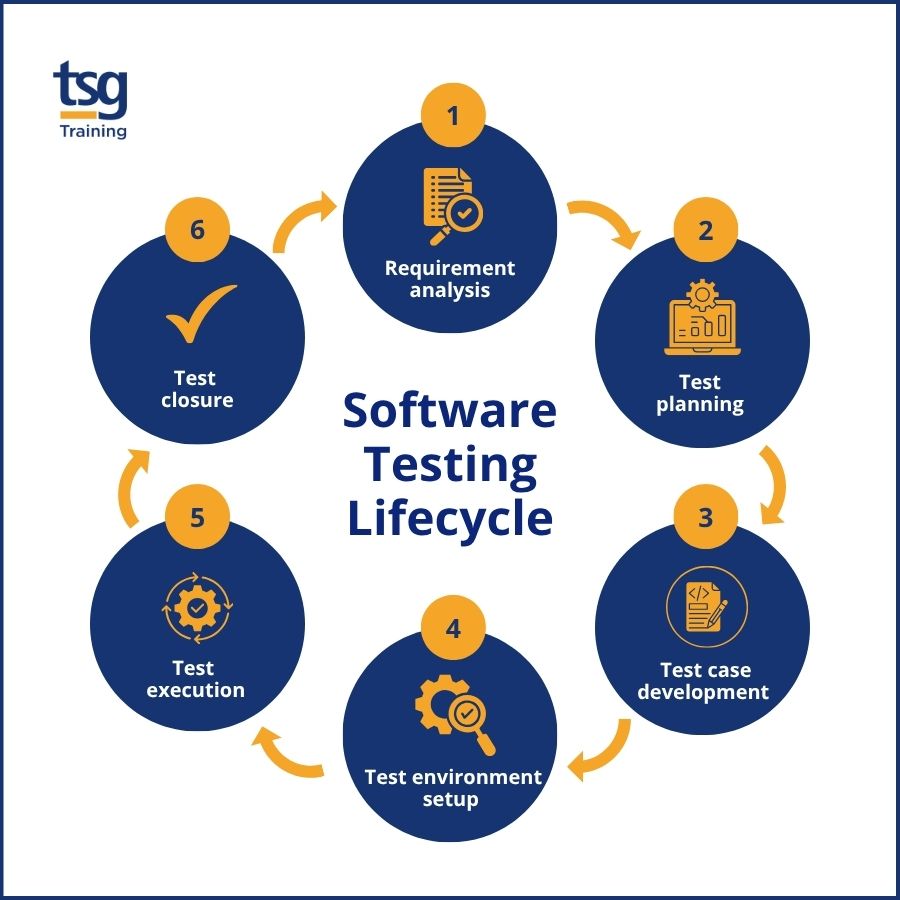
The six phases of the STLC
Requirement analysis
Testers review requirements to identify what is testable and clarify gaps before detailed test design begins. Traceability between requirements and testing may be recorded in a requirement traceability matrix. The phase is complete when the team has enough agreed information to plan meaningful testing.
Test planning
The test plan establishes the objectives and scope of testing. It also defines the approach and resources required. Planning considers factors such as risk and scheduling. Exit criteria are met when the plan provides an agreed basis for organising subsequent testing work.
Test case development
Test conditions are developed into test cases, with test data identified or created to support execution. Coverage is checked against the requirements and agreed test objectives. This phase is complete when the necessary test cases and supporting data are ready for use.
Test environment setup
The required environment is prepared so tests run under suitable conditions. This may involve configuring software or obtaining access to dependent systems. Setup is complete when the environment has been verified and is ready for the planned test execution.
Test execution
Testers run the planned tests and compare actual results with expected behaviour. Results are recorded, and failures are investigated and documented through defect reports where appropriate. Exit criteria depend on the agreed test objectives and the level of remaining risk.
Test closure
Testing concludes by reviewing the completed work and recording relevant outcomes. Outstanding issues are identified and useful testware is retained. A test closure report may summarise results and provide evidence for stakeholders. Closure also creates an opportunity to capture lessons for future work.
STLC vs SDLC
The difference between SDLC and STLC is scope: the software development life cycle covers the development of software, while the software testing life cycle focuses on testing activities within that wider development process. They run alongside each other rather than as consecutive life cycles.
| SDLC | STLC | |
| Scope | Overall software development | Software testing |
| Ownership | Development or cross-functional team | Testing responsibility within the team |
| When it starts | From initial product or system needs | From early analysis of the test basis |
| Produces | Working software and supporting artefacts | Testware and testing evidence |
Testing therefore does not begin after development ends. Early testing activities provide opportunities to identify problems in requirements before those problems are implemented in software.
How the STLC works in agile
In agile development, the STLC activities can take place within shorter iterations rather than following a fixed, sequential process. Requirement analysis may happen as a user story is being refined, with test design following as the team prepares the work. Environment preparation and execution may then happen within the same sprint.
Test closure may also take a different form when there is no single release gate. Teams still review results and unresolved defects, but completion may happen at the end of an iteration or test level. Relevant lessons then feed into subsequent work.
This iterative approach keeps the purpose of the STLC and adapts its timing to the development model.
The STLC in the ISTQB syllabus
The current ISTQB Foundation Level syllabus does not present the six-phase STLC model described above as its formal test process model. This distinction is important for candidates preparing for ISTQB Foundation (CTFL).
CTFL v4.0.1 describes test planning, test monitoring and control, test analysis, test design, test implementation, test execution and test completion. These activities are not necessarily sequential and may overlap or be repeated. Test implementation prepares the necessary testware and environment, then execution runs the tests. Test completion addresses work at milestones such as the end of an iteration or release.
There is clear overlap with the common STLC model, but the terminology is different. For example, what industry articles often call “test case development” is separated across test analysis, design and implementation in ISTQB terminology. Environment setup forms part of test implementation rather than standing as an independent phase.
Candidates should therefore learn the official CTFL terminology for the exam rather than assuming every STLC diagram uses the syllabus wording.
Understanding the testing life cycle also provides useful context for what software testing certification involves and how professional testing practice develops beyond individual techniques.
Get ISTQB certified with TSG Training to build a structured understanding of software testing based on the current Foundation Level syllabus.
Insights & articles
Please complete the form to ensure your quote is accurate and we will contact you soon.