Over 40% off PRINCE2 Project Management live virtual courses - code: P2PMSUMMER26TSG

14 August 2019 | Updated on 16 September 2026
Developing Professional Senior Test Engineers Into Lead Test Engineers
1. Executive Summary This document sets out a vision for developing professional Senior Test Engineers into Lead Test Engineers/Test Team Managers/Technical specialists through a targeted learning an...

1. Executive Summary
This document sets out a vision for developing professional Senior Test Engineers into Lead Test Engineers/Test Team Managers/Technical specialists through a targeted learning and development programme. People passing through the programme will increase their own skills and competencies in multiple disciplines and, importantly, organisational capability to help deliver systems solutions that underpin day to day business operations.
The programme has been developed in concert with (and rolled out to) a major systems integration company that was prepared to invest significantly in training to increase capability and extend its value proposition to new and existing clients alike.
The days of people having a single skill have long gone, so this cogent learning and development programme is based upon achieving multi-skilled competencies for people and organisations in order to maximise staff utilisation and reduce operational costs and staff attrition rates.
The programme comprises five learning and development streams, each of which seeks to imbue people with multi-layered competencies that are relevant to their experience and which provide extended capability within organisational teams - regardless of the development method they employ. The first stream defines a programme for apprentices and people new to testing, with the remaining four streams providing learning matched to career growth and the needs of a modern Test Practice. Each course within a stream has been mapped to SFIA, industry-accepted core principles, competencies and role types, as follows:
- Lead Test Engineerswith at least 4 years' experience who are looking to become test managers with an additional specialism.;
This stream will imbue staff with thy skills they need to manage and ensure the right approach to:
- Test Manage and set strategy for programmes and projects
- Act as a technical specialist in a chosen competency, such as performance or automation
- Act in the capacity of product owner for small to medium-sized projects and programmes
- Assess and mature test process, measurably and demonstrably
- Advise and manage non penetrative aspects of security.
We recommend that the programme of learning be scheduled to run for around 2 years in order to allow students time to use their learning through classroom and on the job training to give them solid learning opportunities as the progress toward graduation. Within the stream is:
- Further details are available on request.
- The following pages contain the training and support details for developing 'Professional Senior Test Engineers' into 'Lead Test Engineers' who are competent managers and technical specialists
- A targeted learning & development programme that provides the necessary foundation for each person to take as part of building their general test capability and career growth;
- A series of optional developmental paths and routes to allow a Test Practice to fulfil its specialist technical needs by developing staff with cross-functional competencies.
For reference only, beyond the stream of learning defined here, there are a further two 2-year development streams to help Lead Test Engineers progress through to Test Architect/Consultant and Test Expert..
2.Principles and Competencies of the Programme
Following our experience of learning and development programmes and research into what companies require of testing in the future, we have defined a series of 'Principles and Competencies' that fit the gamut and need of corporate skills required to deliver first-class systems that help underpin business operations, ranging from raw intake through to experienced Lead Engineers, Architects, and Experts as follows:

3.The 5-Stream Programme
The professional Test Engineer career development programme contains five key streams, with each being rigorously designed and tested to reflect the principles and competencies that are key to success and growing capability within a Test Practice. Each stream interfaces seamlessly to the next to provide continuous investment in people and career growth:

3.1 The Five Key Streams
At the broadest level, each stream is designed to reflect modern test engineering principles, coupled with competencies that meet the needs of a Test Practice using varying development models, supported by capability from competent, multi-skilled individuals.
- The Test Engineerfor apprentices and entry level staff embarking on a career in software testing, and for experienced staff from other disciplines who may be transferring in.
- The Senior Test Engineerwith at least two years' experience, who is ready to step up to using more advanced techniques, choosing to specialise or move to the early stages of team leadership.
- The Lead Test Engineerwith at least four years' experience, already specialising and needing to be ready for the demands of test management or increasingly complex technical roles.
- The Test Architectwith at least five years' experience, ready to make the jump to the business-critical role of defining and building test architectures for major programmes.
- The Test Expertwho has at least 10-years' experience of leading major programme delivery and organisational change and benefit.
3.2 The Lead Test Engineer
The Lead Test Engineer stream is designed for people with at least four-years' software testing on projects and who have expressed a desire to make it their next career goal of test manager or technical specialist and move up the ladder of seniority within a Test Practice.
Students graduating Stream 3, 'The Lead Test Engineer Stream', are expected to join this stream at the beginning, whereas others with relevant experience can join at any point.
3.2.1 The Lead Test Engineer Roadmap

Some courses in Stream 3 are repeated from Stream 2. However, this is only to ensure that everyone has the full skill set. If a course has been taken in Stream 1 then it need not be taken again here.
The stream supports the key competencies of:
- Technical Testing
- Automated Testing
- Performance Testing
- Team Leaders and aspiring Test Managers
- Test Process Improvement
- Security Testing.
Supporting 6 key competencies, Stream 3 contains two mandatory course and 6-optional course paths that allow the Lead Test Engineer to specialise in key skills areas as they progress toward Test Architect/Consultant and Test Expert. Whilst the paths are optional, we recommend that at least one be completed to graduate.
It is the stream where consultancies and systems integration companies can be confident that the key staff have sufficient learning and capability to act as client facing consultant who can lead projects.
It is not envisaged that any of the courses in this stream will be eligible for 'Government Apprenticeship Funding' unless someone is transferring into a role where there is a requirement to learn at least 51% of new skills to fulfil it.
3.2.2 Lead Test Engineer Learning & Development Narrative
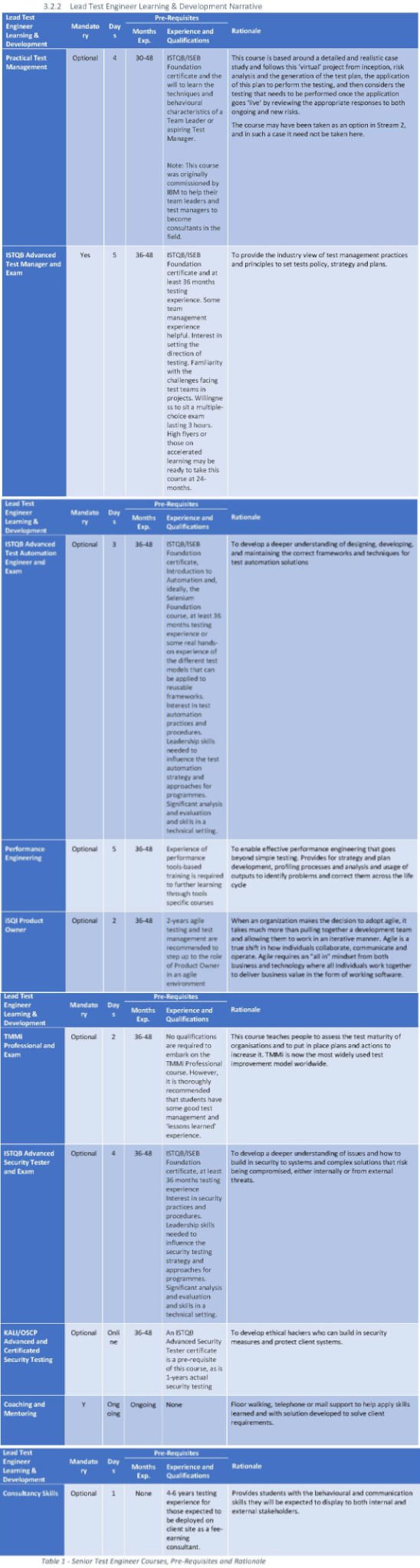
4 Meeting the Needs of the Lead Test Engineer
The programme has been designed to meet the skills of multiple business sectors and companies . It is composed of industry-accepted and proven courses to deliver best-practice training for Senior Test Engineers. The programme provides professional training that will allow Test Engineers to learn and develop on the job as they exercise acquired skills and increase competency in:
- Automated Testing
- Performance Testing
- Security Testing
- Technical Testing.
- Test Process Improvement
- Test Team Leadership/Management
Training shall be delivered in the classroom with:
- An experienced trainer who has real coal face experience;
- A complete course manual and examples on which students can make their own notes;
- Support from the trainer via email for life.
5 Meeting the Needs of the Employer
The programme is based upon industry best practice and support a series of different development methods that are used in the market today.
TSG can work with the employer to define the most suitable work for students to undertake based upon each course.Work is expected to be exercised aligned with the skills learned in Section 4, Meeting the Needs of the Lead Test Engineer, above.
The programme has been defined to turn out best-practice Lead Test Engineers, but it can be modified in technical content to meet the specific needs of any particular methods, environments, skills and architectures as the employer may rely upon to underpin their business systems.
6 Benefits of the Approach
In helping to meet the requirements of building capability within a modern Test Practice we have clearly delineated the roles and mapped them to training functions to be supported, aligned with stated principles and competencies:
- Courses will be delivered by experienced staff who have at least 20-years' experience gained from training and programme delivery at the sharp-end.
- The experience the trainers bring will allow them to offer the ever-important analogies and war-stories to make training relevant and accessible.
- Courses can be tailored to meet specific requirements; although for ISTQB courses we are limited to 10% variation without having to reaccredit.
- We can provide private training courses anywhere or staff can attend any of the courses that we run on our public schedule.
- We will agree and put in place a monitoring and measurement system to make sure that:
- The delegate experience is rich.
- People are passing exams at the expected rate.
- The overall programme is delivering against its aims.
A. Training & SFIA Cross Reference
The following table identifies:
- The Knowledge Levels (K) that each course and exam is aimed at:
- The SFIA Levels and the suitability of courses by the identified role types.

Insights & articles
Please complete the form to ensure your quote is accurate and we will contact you soon.